Hardwood Flooring Terminology
a guide to the technical terms of wood flooring
Adze
An Adze is an ancient type of edge tool dating back to the stone age. Adzes are used for smoothing or carving wood in hand woodworking, similar to an axe but with the head mounted perpendicular to the handle. The blade of an adze is set at right angles to the tool's shaft.
Basketweave
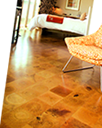
A patterned floor which comprises various interlocking blocks lain in sets of 4, with each set at a right angle.
Bird's Eye
A distinctive figure in Maple which is said to look like a bird's eye.
Brushing
The brushing process highlights the natural flow of grain and removes the softer summer growth fibres from the floors surface.
Distressed
A process wood floors go through to produce the 'lived in' look.
Faceted
Faces of a column cut in a polygonal form.
FSC
FSC stands for 'Forest Stewardship Council'. FSC certifies forests all over the world to ensure they meet the highest environmental and social standards.
Products that are made from wood or paper from FSC forests are marked with their logo so you can be confident that buying it won't mean harming the world's forests.
Fumed
Fuming is a wood finishing process that darkens wood and brings out the grain pattern. It consists of exposing the wood to fumes from a strong solution of ammonium hydroxide which reacts with the tannins in the wood. Fuming has an advantage over staining in that it does not obscure the grain, it just darkens it. Unlike staining, there is no possibility of blotches or runs. Fuming is also colourfast. Different batches of wood will react to fuming differently.
Grain
Grain is the alternating regions of relatively darker and lighter wood resulting from the differing growth parameters occurring in different seasons.
Heart
The core of the tree from which growth rings emanate.
Herringbone
A traditional past that has been used for many years to create an interlocking pattern of blocks.
Lacquer
Lacquer is another name for floor seal. Lacquers are often polyurethane-based in a water-borne solution.
Liming
The lime bleaches the Oak and this turns it white. This achieves a soft, pastel appearance.
Pippy
Small clusters of knots, that are collectively called Pips or burrs. The very heavy concentrations are called Burrs. Usually desired in Oak but also found in Elm and Sycamore. They are also mainly found in the United Kingdom, and rarely found in either Europe or North America.
Plancher Du Quercy
Placher is a French term for a slab or plank of Oak used for a floor. Quercy is named after the Latin 'Quercus' meaning Oak. Quercy is the region of France prized for it's fine Oaks.
Raw Oiled
Raw Oiled is designed to give the appearance of an unfinished floor with the added protection of a Ted Todd UV oil finish.
Rippled
An unusual type of figure that looks like a ripple across the width of a plank. Highly prized and found in Maple and Sycamore.
Satra Level
The Satra Level is the slip resistant test. All of Ted Todd's flooring are a Satra Level 9.
Thermo Oak
Thermo Oak treatment brings out and emphasizes the best characteristics of the wood. The colour is a deep chocolate brown which exists throughout the wood.
The boards are heated to a high tempreture which causes the colour to darken. There are no chemicals used in this process, just simply heat and steam.
Tumbled
A tumbled floor has a very similar looking finish to a distressed floor but the process is quite different. Tumbling takes place in giant drums where planks are placed with damaging objects to distress the wood. The advantage of tumbling is that the edges of the boards becoming distressed as well as the surfaces which means that the floor takes on a more overall distressed appearance.
Un-Finished
Un-prepared, raw timber requiring sanding and sealing after installation.
UV Oiling
UV oiling is a finish that combines base coats of natural oil with a surface top coat layer that is hardened with Ultra Violet light. The UV hardened topcoat makes the floor more resistant to watermarks and staining.
Wax
A paste applied to the floor surface which protects the wood from traffic wear. Waxes improve the luster of a floor and are used to create a period, restored feel. Several coats are applied to build up the finish, which is then polished either mechanically or by hand to create a warm, shiny floor.